
Birth Chart
What is it and What can we Learn from it?
Zodiac, Planets and Constellations
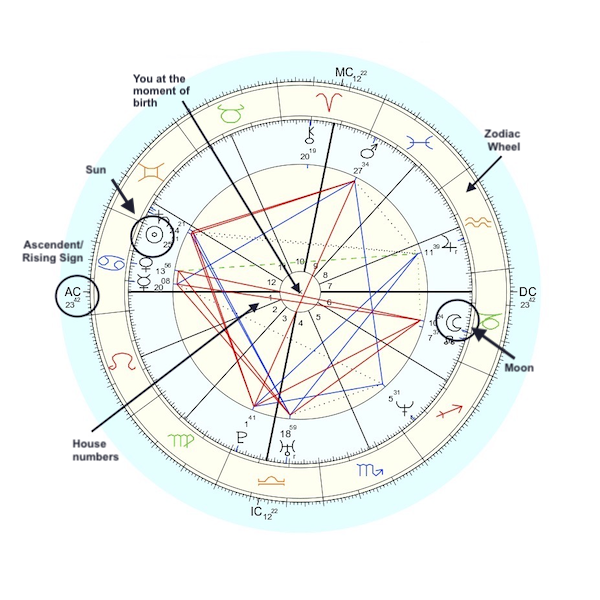
A birth chart is a snapshot of the heavens at the moment of your birth. The inner circle of the chart represents the Earth at that moment — and therefore you, the person being born. The outer circle represents the zodiac wheel, which is divided into twelve sections known as the zodiac signs.
Historically, these signs were associated with constellations — groups of stars that form recognizable shapes in the sky. For example, the constellation resembling a scorpion corresponds to the sign of Scorpio.
A full circle contains 360 degrees. Because the zodiac is divided into twelve signs, each sign occupies 30 degrees of the zodiac wheel.
Sun, Moon and Planets
When we describe a birth chart as a snapshot of the heavens, we are referring to the positions of the Sun, the Moon, the planets, and other cosmic bodies in relation to the zodiac wheel at the exact moment of your birth.
For example, if your birth chart shows that your Moon is in Cancer, it means that at the moment you were born, the Moon was located in the area of the sky associated with the sign of Cancer. In other words, if someone had been standing beside you at that moment and looking up at the sky, the Moon would have appeared in the region of the zodiac corresponding to Cancer.
Houses, Rising Sing and Cardinal Points
In addition to the twelve zodiac signs, the birth chart is also divided into twelve houses. While the zodiac signs each occupy an equal portion of the circle (30 degrees), the houses are not always equal in size.
The first house begins at the Ascendant, also known as the AC or Rising Sign. It is called the rising sign because it represents the zodiac sign that was rising on the eastern horizon at the moment of your birth. If the birth chart were imagined as a clock, the Ascendant would be located at approximately the 9 o’clock position.
The Ascendant is one of the four cardinal points of the birth chart, which are essential reference points for interpretation. The other three are the Descendant (DC), associated with relationships; the Midheaven (MC), connected with career and public life; and the Nadir or Imum Coeli (IC), which relates to home, roots, and childhood.
Understanding the Birth Chart
Reading a birth chart means understanding how the positions of the planets and other cosmic bodies in the zodiac signs and houses, as well as the placement of the cardinal points, are expressed through your personality and life experience.
Each planet and cardinal point represents a different dimension of your personality. For example, Mars describes how you act and pursue your goals, while the Moon reflects how you experience and process emotions.
The zodiac signs show how these aspects of your personality are expressed. For instance, Mars in Gemini may pursue goals through communication, networking, and exchanging ideas, while Mars in Capricorn tends to achieve goals through discipline, persistence, and hard work.
The houses show where these energies are most likely to manifest in your life. For example, Mars in Capricorn in the 2nd house suggests that disciplined action may be directed toward building financial security. Mars in Capricorn in the 9th house suggests that disciplined effort may be devoted to higher learning, philosophy, or spiritual study.
Other Things You Can Learn from your Birth Chart
Elemental Balance
Imagine driving a car with the wrong amount of air in your tires. If one tire is overinflated or underinflated, the car will not drive smoothly or efficiently. In the same way, the balance of elements in your birth chart can reveal where you may feel naturally supported and where you may feel out of balance. Understanding your elemental balance can teach you a great deal about yourself. My teacher, Debra Silverman, wrote an entire book on this topic, The Missing Element, which I strongly encourage you to read.
Aspects
The relationships between the Sun, the Moon, the planets, and the cardinal points are called aspects. Aspects describe how these different parts of the chart interact with one another, and they can reveal both strengths and challenges within your personality. The zodiac signs themselves also relate to one another in meaningful ways. You can learn more about this by studying the three modalities and the relationships between the zodiac signs.
Life Direction
Your birth chart can also offer insight into your life direction and purpose. The Midheaven, for example, can provide clues about the type of career or public role that may feel most fulfilling to you. The South Node and North Node can reveal patterns and habits that may hold you back, as well as the evolutionary path that supports your personal growth.
There is much more that can be learned from a birth chart, but for now we will focus on the fundamentals.


